VLA Operations Public Page
About the Array Operators
While operating the radio telescope and running astronomical observations, the Array Operators are responsible for monitoring all of the telescope's systems and the raw astronomical data gathered by it. Additionally, Operators help ensure personnel and equipment safety by keeping track of and communicating with personnel on the array, notifying them of dangerous weather conditions, monitoring fire alarm systems, responding to emergencies, alerting technicians to high equipment temperatures, and other serious hardware problems. Operators stow the antennas when wind speeds exceed the safety threshold, correct problems when possible, report problems to the appropriate technical group, and inform observers of any problems to aid them when they process and study their observation data.
Operators generally have degrees in Astronomy, Physics, Electronics, Engineering, or other STEM fields, and/or previous experience working at an astronomical observatory. Specialized education and experience is helpful to Operators in that it enables them to better understand how the telescope works, how it's performing, and what the symptoms, causes, and effects of a problem may be. Operators also have experience working with computers, electronics, and scientific equipment & instruments. Operators work 8-hour shifts (day, evening, and night), and an irregular schedule where work days and shifts change from week to week. There is an Operator on duty 24 hours a day, 7 days a week.
Being an Array Operator at the Very Large Array requires an exceptional ability to multi-task and adapt to a frequently changing environment. Operators must routinely interact with EVLA systems using several different computer operating systems and software applications to ensure the integrity of every scientific observation that is run. It is the Operators' responsibility to ensure that each of the EVLA's systems (there are hundreds of different monitoring points per antenna) functions within established parameters. There is usually only one Operator on duty and s/he must know how to troubleshoot, and in some cases fix, the myriad of problems that can arise. When the Operators cannot fix a problem themselves, they can notify any number of technicians who are on-call anytime to come out to the site for repairs. A typical day at the observatory will involve:
- Constant monitoring of multiple computer screens to ensure that:
- each EVLA antenna is configured correctly and operating normally, and
- raw astronomical data quality is good and data is being processed normally
- Assisting observers and scientific staff whose tests or observations are running
- Working with engineers, technicians, programmers, and others to help resolve hardware and software problems
- Maintaining an accurate observation log and documenting any problems that may affect astronomical data
- Responding to and managing radio calls and traffic from workers and technicians in the field
- Performing system tests to measure values used to finely tune each antenna
- Generating detailed maintenance reports for system faults and malfunctions
- Taking corrective action when errors and faults occur
- Answering questions from visitors and tour groups
Operating at radio frequencies, the VLA observes the sky 24 hours per day, 363 days per year, in all but the most severe weather conditions. The telescope can currently observe 10 different frequency bands ranging from approximately 74 MHz (4-band) all the way up to 50 GHz (Q-band), and in a given day may observe astronomical objects such as supernovae, hydrogen gas clouds, gamma ray bursts, active galactic nuclei (AGNs), and occasionally even the sun or planets.
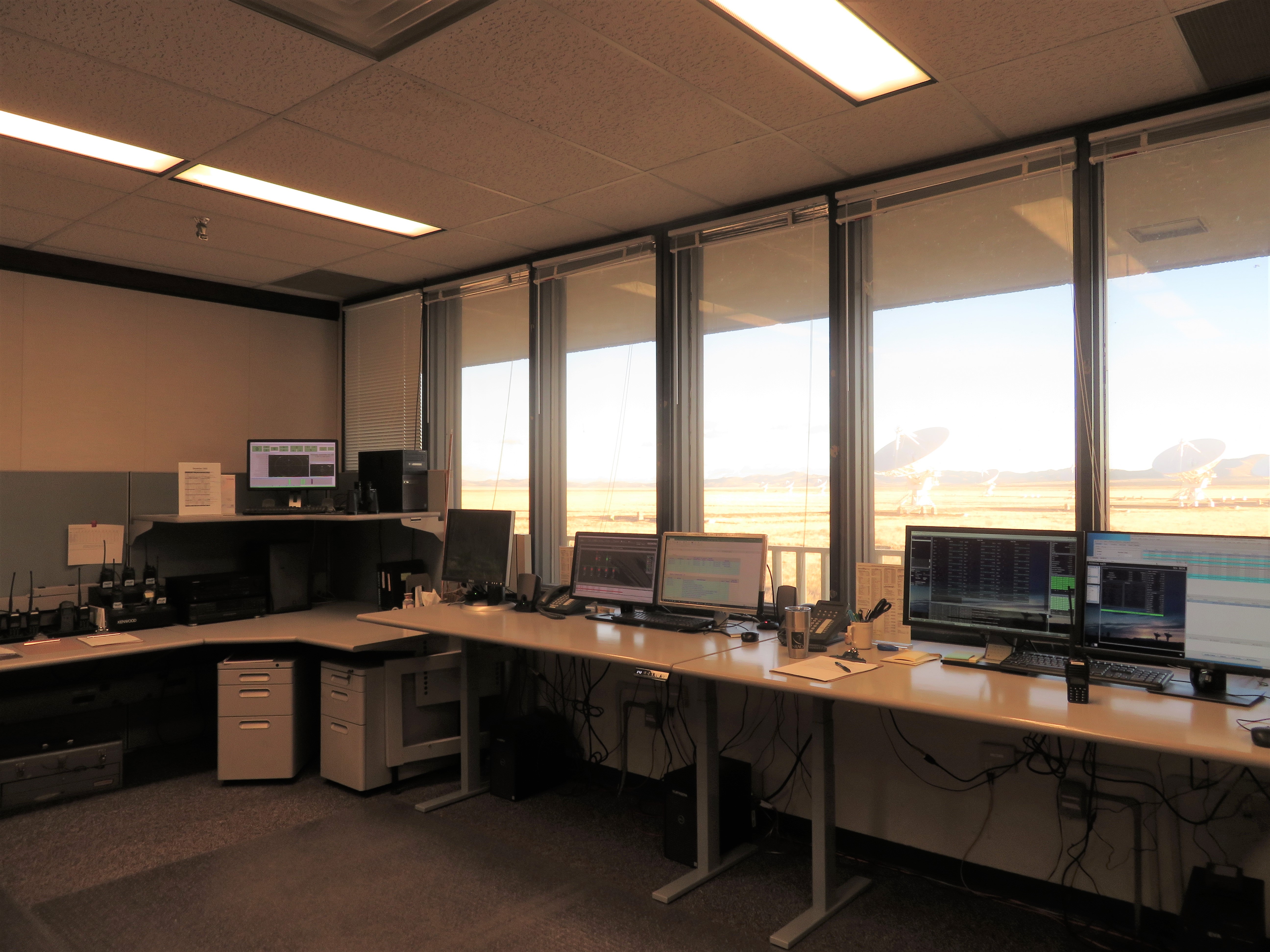
This is the left section of the VLA Operations Control Room. The computer to the upper left is running a real-time lightning detection program. The Operators must warn personnel and visitors of any lightning occurring within 10 miles of the array. The computers on the desks are Windows and Linux computers that contain software, documents and various applications the Operators use on the job. The dark monitor on the left is where the Operator's perform miscellaneous administrative tasks, the rest are all used for the real-time operation of the observatory.
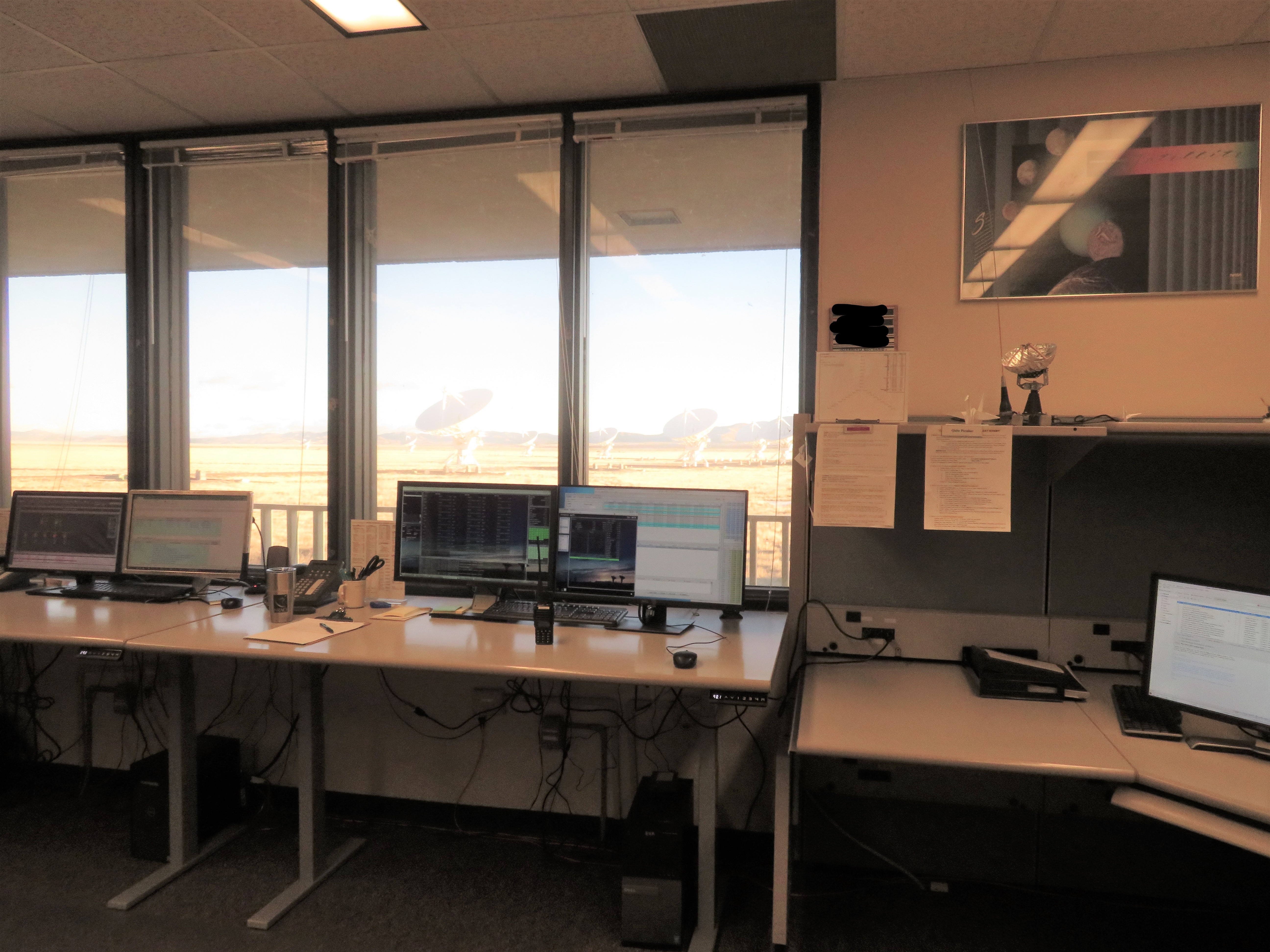
This is the center section of the VLA Operations Control Room. The monitors on the left show the site generator status and the active observing log for the current observation being run. The Operator must create a separate log for each observation. These logs contain information about the weather conditions, any problems that will cause data loss or corruption, and other important occurrences or issues that the observer needs to know about. The monitors in the middle are display real-time telescope array information and the monitor on the right displays weather conditions from the weather station next to the Control Building along with other applications necessary for operations.
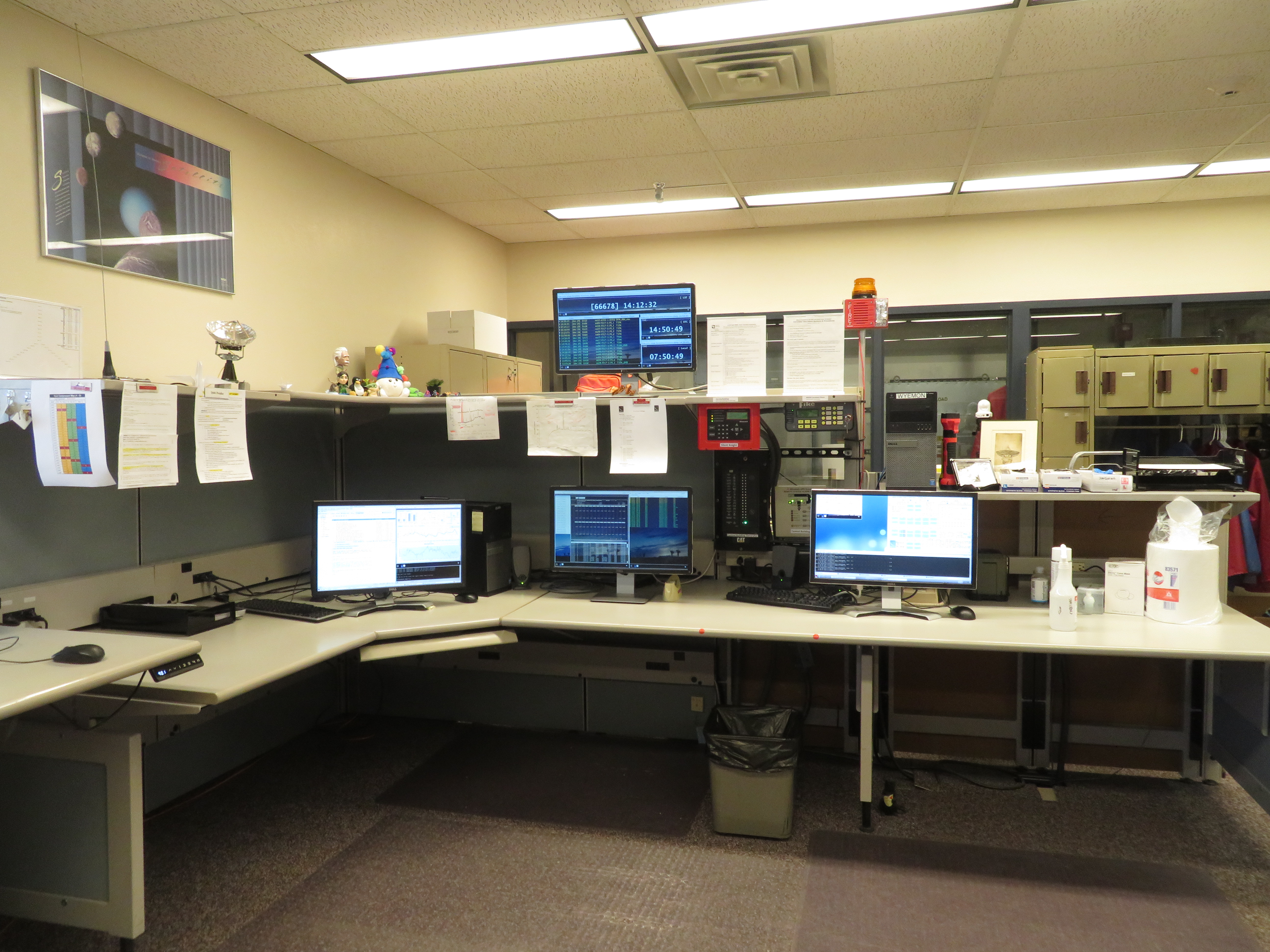
This is the right section of the Operations Control Room. The monitor on top displays the current time in LST (Local Sidereal Time), UTC (Coordinated Universal Time) and MT (Mountain Time - our local time). It also displays alerts from the antennas and the the Correlator. Below are more monitors displaying real-time information about signal amplitudes for each antenna as well as the health of the Correlator. There are also four alarm and alert panels; VLA site fire alarm, Correlator fire alarm, UPS (Uninterruptible Power Supply) system, and Control Building generator.

This is the far right section of the Operations Control Room. The monitor on the top shelf displays both the current IAT (International Atomic Time) and the LST (Local Sidereal Time). Below this are 2 remote control panels for the site and Widar correlator fire alarm systems and the site UPS system. The wide-screen monitor on the lower table is a display of the main Widar Correlator user interface which allows the Operators to monitor critical readings such as temperature and power. The CRT touch-screen monitor on the middle shelf and the rack-mounted computers below are part of the Wye Monitor system, a redundant utility control that alerts the Operators to certain critical faults and provides a means to reset certain systems.